AI Smart Glasses in 2026: What They Can Already Do Without a Smartphone
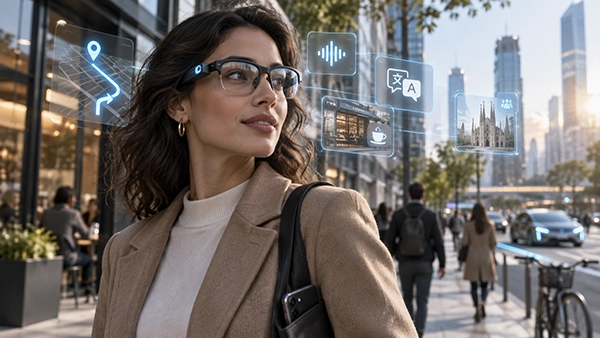
AI smart glasses have moved beyond being simple camera-equipped accessories. In 2026, several models can listen to voice commands, understand what the wearer is looking at, translate conversations, show directions, display short pieces of information and provide AI-generated answers while the phone remains in a pocket or bag. That does not necessarily mean the smartphone has disappeared from the process. Some glasses carry out selected tasks locally, while others still depend on a phone for connectivity or processing. The important change is that many everyday interactions no longer require looking at a separate screen.
What AI Smart Glasses Can Do Hands-Free in 2026
Voice interaction is now one of the most mature features. Current AI glasses can respond to spoken requests, answer general questions, control music, initiate calls and help with everyday tasks without requiring the wearer to tap through a phone interface. Meta’s current glasses, for example, use the “Hey Meta” command for AI functions, while Even G2 offers “Hey Even” voice activation. The experience is closer to speaking naturally to an assistant than navigating menus on a small wearable device.
Translation has also become considerably more practical. Compatible Meta glasses can listen to a conversation and provide translated speech through their open-ear speakers. On Meta Ray-Ban Display, translated text can appear directly in the wearer’s field of view. This can be particularly useful when travelling, speaking with international colleagues or dealing with short everyday conversations where repeatedly checking a translation app would interrupt the exchange.
Navigation is another area where the phone can remain out of sight. Display-equipped glasses can place simple route information where the wearer can see it while walking. Even G2, for instance, provides hands-free directions in its display. Google’s Android XR eyewear programme is also being built around voice-controlled navigation, messaging, photography and other tasks that can be started directly from the glasses rather than by opening the corresponding phone app.
Seeing, Hearing and Responding to the Wearer’s Surroundings
The biggest difference between conventional voice assistants and newer AI eyewear is context. Camera-equipped glasses can analyse what the wearer sees instead of relying only on a spoken question. Meta has demonstrated features that recognise physical text, including menus, documents and signs. A wearer can look at written information and request a translation, explanation or other contextual assistance without first photographing it manually and sending the image to an AI service.
This visual understanding makes simple requests much more natural. Instead of describing an object in detail, a person can ask a question about something in front of them. The glasses can combine camera input with the spoken request and return an answer through audio or, on models with a display, visually. Local AI processing is becoming more important here because some recognition tasks can be completed on the device rather than sending every step through a remote service.
Not every pair of AI glasses follows the camera-first approach. Even G2 deliberately omits both an outward-facing camera and speakers. Its focus is information displayed discreetly in front of the wearer, supported by microphones, touch controls and optional ring input. Functions include an AI assistant, transcription, translation, a teleprompter, notifications, calendar information and navigation. This illustrates how different manufacturers are approaching the same idea from different directions rather than building identical products.
How Close Smart Glasses Are to True Smartphone Independence
The phrase “without a smartphone” needs to be interpreted carefully in 2026. Many glasses allow users to complete a task without physically touching their handset, but the phone may still be maintaining the internet connection, running a companion app or providing access to services in the background. From the wearer’s point of view, the interaction feels independent because the entire conversation happens through the glasses. Technically, however, the smartphone can still remain an essential part of the system.
Even G2 is a clear example. Even Realities states that its current functions require both a Bluetooth connection and an internet connection. The glasses themselves contain displays, microphones and controls, but much of the software runs through the paired phone. If that connection disappears, the full feature set is unavailable. The G2 therefore reduces the need to look at a phone rather than replacing the phone itself.
Meta is moving further towards processing tasks directly on eyewear. The company says its on-device AI technology is already used for functions such as live translation, visual captions and recognition of text in the wearer’s surroundings on Meta Ray-Ban Display. This reduces latency and allows selected processes to happen locally. Even so, online AI services, account functions, communications and many connected features can still depend on internet access or a companion device.
Where the Phone Is Still Doing Hidden Work
Connectivity is one of the main reasons smartphones remain involved. AI assistants often need current online information, cloud-based language models, maps, messaging services or music accounts. A pair of glasses may provide microphones, cameras, displays and local processors, but maintaining a separate mobile data connection inside a lightweight frame adds cost, power consumption and engineering challenges. Using a phone that the wearer already carries remains a practical solution.
Battery life creates another limitation. Smart glasses have to fit processors, wireless components and sensors into frames that are comfortable enough for long periods of wear. Running advanced AI continuously on the glasses would consume significantly more power. Manufacturers therefore divide tasks between the eyewear, the connected phone and remote servers. This arrangement can give users more capable AI while keeping the frames closer to the size and weight of ordinary glasses.
The distinction between local and remote processing also matters for privacy. A task performed directly on the device does not necessarily require the same data transfer as a cloud-based request. Camera-equipped glasses add another consideration because people nearby may appear in images or audio recordings. Models without cameras, such as Even G2, take a different approach by limiting what the glasses can capture. Buyers therefore need to consider not only what AI glasses can do, but also what information each feature requires.

Which 2026 Products Show Where AI Glasses Are Heading
Meta Ray-Ban Display represents one of the clearest examples of AI moving from audio-only assistance towards information presented directly in front of the eye. The display can provide captions, translated text and contextual information, while a camera allows the system to understand parts of the wearer’s surroundings. Gesture control through the Meta Neural Band adds another input method, allowing some interactions without speaking or reaching for a phone.
Even G2 takes a noticeably different route. Its binocular micro-LED display can show AI responses, navigation instructions, notes, notifications, calendar information and conversation-related prompts. Even Realities also offers Conversate, which can provide contextual cues during discussions and create summaries afterwards. The absence of a camera and speaker makes it less suitable for visual recognition or audio playback, but it also gives the product a more discreet character.
Google is preparing another significant step with Android XR intelligent eyewear. At Google I/O in May 2026, the company announced audio glasses developed with Samsung and eyewear brands including Warby Parker and Gentle Monster, with availability planned for autumn 2026. Google says Gemini will support tasks such as directions, messages, photography and questions about the wearer’s surroundings. Separate display glasses are also planned, although Google had not announced a comparable consumer launch date for them by September 2026.
What Buyers Should Realistically Expect from AI Glasses Now
Anyone considering AI glasses in 2026 should first decide which type of assistance is actually useful. Camera-and-audio models are better suited to taking photos, recognising objects, understanding signs, listening to music and answering questions about the immediate surroundings. Display-focused glasses are more appropriate for users who want text, directions, prompts, live transcription or notes positioned discreetly within their view. Neither design is automatically better because they solve different problems.
It is also worth checking exactly what happens when the paired phone is unavailable. Marketing descriptions often focus on the fact that users do not need to take their phone out, which is genuinely useful but different from complete independence. Battery life, internet requirements, supported languages, prescription-lens availability, privacy controls and regional availability can have a greater effect on everyday use than the headline AI features themselves.
By September 2026, smart glasses have reached a stage where the smartphone can stay in a pocket for a growing number of everyday interactions. Voice assistants, live translation, contextual visual help, navigation, transcription and discreet displays are already real consumer features rather than laboratory demonstrations. Full smartphone independence remains uncommon, but the direction is clear: more processing is moving onto the glasses, displays are becoming more practical, and AI is increasingly turning eyewear into an interface that can be used while looking at the real environment rather than at another screen.